
SDVI Corporation today announced the next generation of its Rally media supply chain management platform, introducing a redesigned orchestration engine that represents the most substantial evolution of the Rally platform in the company’s history. The new platform gives media operations teams more powerful supply chain orchestration, a significantly simplified user experience, and new tools for building, managing, and evolving supply chains at scale. Key capabilities include a new graphical supply chain builder, a modular supply chain functions layer, and a new foundation for agentic AI integration. The new platform will be showcased at the 2026 NAB Show in Las Vegas, where SDVI will be demonstrating the full range of new capabilities at booth W1553 in the West Hall.
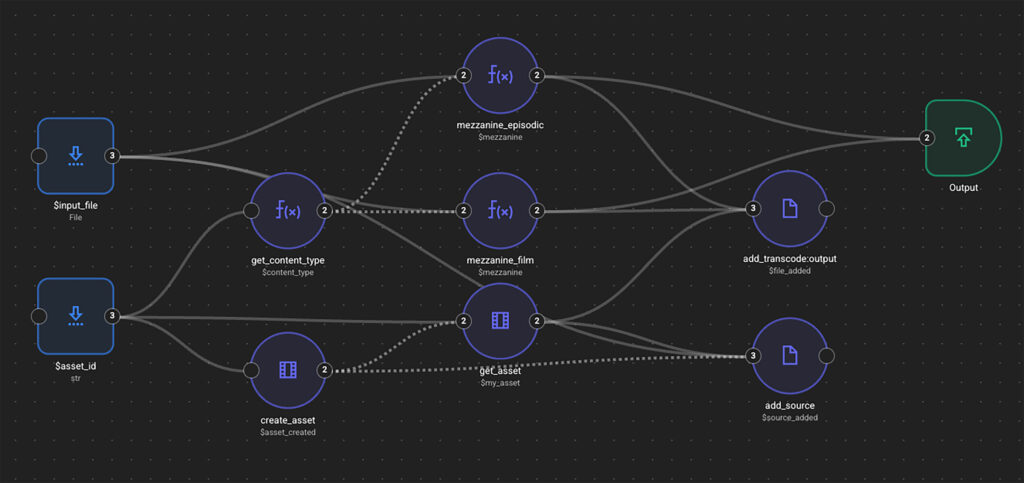
Redesigned Rally Orchestration Engine
At the core of the next-generation Rally platform is a redesigned orchestration engine built on a declarative supply chain architecture that separates the control plane from the data plane. This architectural shift enables a new set of capabilities that fundamentally change how media supply chains are constructed, operated, and evolved:
Declarative Supply Chain Definitions — Supply chains are now defined using a structured declarative approach that separates the control plane from the data plane, making them easier to version, audit, share, and reuse across the organization. Support for nested supply chain definitions (SCDs) allows complex workflows to be composed from modular, reusable subchains, enabling greater consistency and flexibility across large-scale operations.
Graphical Supply Chain Builder — A new visual interface allows operators and engineers to design, build, and monitor supply chain workflows graphically, providing a consistent environment across the full supply chain lifecycle. The builder makes it faster and more intuitive to construct and modify workflows without requiring deep technical expertise.
Supply Chain Functions — A new functions layer introduces modular, reusable building blocks for common supply chain tasks. SDVI provides a library of prebuilt functions, and customers can bring their own, enabling teams to standardize on proven patterns while retaining the flexibility to build custom logic where needed.
Supply Chain Rewind — A new rewind capability enables operators to step back through supply chain execution during a live run, providing a powerful tool for failure analysis and root cause investigation that dramatically simplifies troubleshooting complex workflows.
“The next generation of Rally is something we have been building toward for a long time, and we are proud to be bringing it to market now,” said Chris Brähler, chief product officer for SDVI. “By redesigning the core orchestration engine around a declarative architecture that separates the control plane from the data plane, we have created a platform that is fundamentally more flexible, more scalable, and more accessible — both for the engineers who build supply chains and the operators who run them every day. The graphical supply chain builder, modular functions layer, and agentic AI interface are not features added on top of the existing platform; they are expressions of a new architectural foundation. We believe this positions Rally — and our customers — to meet the demands of media operations for years to come.”
Agentic AI Interface
The next-generation Rally platform includes a new foundation for integrating AI agents and large language model (LLM) tools directly into supply chain operations, positioning Rally as a first-class component in an agentic AI environment. A new MCP (Model Context Protocol) server enables external AI systems to interact with Rally — querying for asset metadata, supply chain status, and operational information, and triggering and controlling supply chain execution based on real-time data and external signals. Because Rally supply chains are expressed in a structured, human-readable definition language, AI agents and language models can also read, interpret, and author them directly — enabling intelligent systems to generate or adapt workflows on demand, without any manual authoring step. Natural language interfaces allow operators to interact with supply chains using conversational prompts, making it faster and more accessible to configure workflows and monitor operations. SDVI has designed this as an extensible foundation for progressively deeper AI integration, with a long-term vision of enabling fully autonomous, AI-driven media supply chain operations. SDVI will offer a first look at these capabilities at NAB 2026, demonstrating how AI agents and LLM tools can interact with and orchestrate Rally-managed supply chain workflows.