February is my favorite time of year at SDVI because that’s when we release our “By the Numbers” infographic, in which we describe the amount of work performed by the SDVI Rally platform over the previous year.
One of the most remarkable stats for 2025 is that Rally managed nearly 1 billion jobs across our customers’ global media supply chains. And many of those jobs were video processing jobs, such as transcodes and captioning projects, that require running a third-party application.
When I saw the huge numbers for hours of content processed and jobs performed, it struck me that we don’t often explain how Rally does it — everything involved in cloud infrastructure management for modern media supply chains.
I’ve written before about how Rally brings value in terms of freedom to choose, freedom to experiment, and the ability to apply the right tool for the job, for every job. I often talk about how the elastic nature of the cloud allows Rally to spin up and spin down cloud instances as needed. I’m happy to boast about the many different providers within the Rally Application Services ecosystem. But I don’t often dig into what’s really happening “under the hood” and why it matters for Rally users.
In short, Rally combines infrastructure management with orchestration to ensure that the infrastructure needed to get the work done is always available and always right-sized for the demand.
But there is more to it than that ….
A Little Rally Magic: Application Services Providers
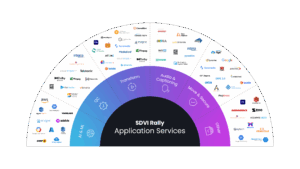
The whole notion of providers is one of the little magics of Rally. Within the Rally Application Services ecosystem, application services providers are third-party or partner tools that have been integrated into the Rally platform so that media companies can instantly access and run that tool’s capabilities on demand, without separate procurement or complex integration. These providers — more than 70 of them — deliver best-in-class media processing functions that Rally automatically provisions, executes, and scales in the cloud.
Rally users can selectively leverage this array of applications on a pay-as-you-go basis, and it all works seamlessly thanks to dynamic provisioning and resource management. Likewise, if a customer already has some application licenses, Rally can utilize those first before bursting additional workloads to on-demand usage. This behind-the-scenes work remains largely invisible to Rally users, but it makes all the difference for a media organization working to make operations more agile, intelligent, efficient, and scalable.
When the Rally platform initiates a job to be performed by an application service provider, it first selects the appropriate machine image, which dictates what type of instance — essentially a virtual machine — and how much block storage to spin up for that provider. Together, these resources support the application code, communications between Rally and the application, and the actual work being performed.
The machine image may be an Amazon Machine Image (AMI) or a generic version for Google, Alibaba, or another cloud vendor, or even a Docker image. Regardless, SDVI’s technical team invests significant effort to create and then benchmark a machine image for each provider. By generating application-specific templates that ensure optimal provisioning, this work pays dividends over and over again for Rally users.
 Because Rally has access to this robust library of parameters, or templates, it can evaluate the trade-off between the highest quality or fastest speed and the cost, and then launch instances as needed. Without any intervention by engineering, the platform identifies and delivers the ideal technical resource for the application being run.
While one storage block facilitates ongoing Rally interaction, another is used for content processing work. If needed, content moves from the user’s cloud-based object storage repository to the block storage module for processing, and the result is moved back to object storage. And then when the provider notifies Rally that the job is complete, Rally spins down all those storage resources.
The platform’s provisioning of infrastructure is informed by proprietary algorithms that calculate the number of virtual computers needed to spread the workload optimally. As a result, Rally knows what resources to spin up for a given application and how to scale and apply them. Doing all this in the background, the platform delivers cloud infrastructure based on the workload and the throughput required for a given application.
Handing Off the Heavy Lifting
In provisioning and managing infrastructure, Rally takes responsibility for all the compute and storage resources used to support applications and the transformational processing work they do. Just as orchestration and automation enabled by Rally frees operators across the supply chain to do higher-value work, the platform’s dynamic infrastructure management frees up technical teams to focus on other areas of operations, such as building end-user-facing applications or doing more in-house testing of new creative tools.
Managing a single application service and its supporting servers, storage pools, virtual machines, and software instances may not seem burdensome. But for the 20 or 30 different applications commonly used across a media supply chain, the time, effort, and expense of this work compound quickly.
 For every use of every application, Rally eliminates time spent booting or shutting down servers, benchmarking and maintaining machine images, and balancing cost and performance. Users can simply deploy the applications they need when they need them. They don’t have to calculate, instantiate, or configure the technical underpinnings necessary to get the right resources applied to the job. When a job is done, Rally applies the intelligence and the cleanup activity needed to spin everything back down and make sure nothing is left running (and racking up charges).
With every additional bit of work that an organization can migrate into a highly automated Rally-managed supply chain comes a further reduction in time and money invested in infrastructure management. As an organization adds use cases to the supply chain, those benefits scale.
Finally, by providing visibility into cost-per-asset for each job executed, Rally gives organizations actionable intelligence they can use to run operations more efficiently and to make faster and better decisions. Consumption pricing, based on the application used, the infrastructure deployed for that application, and the duration of the job, brings greater simplicity and transparency to cloud-enabled operations. In a Rally-managed environment, users know what jobs cost, and they can be confident that they’re paying only for the infrastructure needed to support those jobs.
Infrastructure Management as a Strategic Advantage
While the business case for Rally centers around accelerating revenue or optimizing processes across the supply chain, there is more to the story. Though it happens in the background, organizations working with Rally also realize efficiencies and savings through automated infrastructure provisioning.
Rally was designed from the beginning not just to orchestrate work, but to understand — and intelligently provision — the infrastructure required to complete that work. By tightly integrating resource provisioning with orchestration, the platform removes an entire layer of operational overhead that organizations would otherwise have to manage themselves. The result is a supply chain that is not only more agile and efficient, but simpler to operate and scale. Multiplied across hundreds, thousands, or even millions of jobs, that simplicity becomes a structural advantage that yields measurable operational and business gains.
—
If you’re interested in how automated infrastructure provisioning and management could reduce the burden on your technical team (and budget), get in touch! We’d be happy to talk it through with you.