update April 2026
That’s a Wrap on NAB 2026
From the show floor in the West Hall to our Connect reception at Allegiant Stadium, it was a week that reminded us why this industry shows up to Las Vegas every spring — and what’s possible when the right people and the right technologies come together.
The highlight of the week: Iyuno was recognized with the NAB Show Project of the Year award for their Rally deployment. Iyuno operates at a formidable scale — 45 studios across 29 countries, processing thousands of assets per week. Their move to a cloud-native Rally supply chain changed what was operationally possible.
“Rally has significantly improved the efficiency of our localization services,” noted Chase Logan, VP of Global Media Operations at Iyuno. “For migration and other large-scale processing projects, Rally has allowed us to increase throughput and handle projects that previously would have been impossible to execute.”
We were thrilled to share the week with customers, partners, and colleagues — and to raise a glass with many of you at our Connect reception. Thank you to everyone who joined us.

Supply Chain Thinking
Top Line + Bottom Line: What if Your Supply Chain Transformation Could Benefit Both?

Geoff Stedman, Chief Marketing Officer
In the days following NAB, there’s always a lot to process. What struck me most this year, however, was the change in the way colleagues and customers talk about media supply chain transformation. While media organizations still focus on operational improvements, they have intensified their focus on business impact. And, increasingly, that means both the bottom line and the top line — lowering cost per asset and driving higher revenues.
Most media organizations begin their transformation journey with the same fundamental goal: to reduce costs. By applying supply chain thinking — eliminating waste, automating repetitive tasks, and leveraging cloud infrastructure that scales with demand — those improvements show up quickly. Cost per asset goes down, manual touches decrease, and throughput increases. But as many of our customers discover in shifting to elastic, cloud-based environments, that’s just part of the story.
Organizations go into supply chain modernization projects expecting to reduce costs. What they discover — often as a positive, unintended consequence — is that an agile supply chain also enables revenue. Sales teams can commit to new licensing deals, knowing that operations can meet the demand. Content that once would have required months to prepare and deliver can be turned around in days. Volume that once would have overwhelmed fixed, on-premises infrastructure can be handled on elastic cloud resources that scale up as needed. In other words, the supply chain contributes to the top line.
As those conversations at NAB suggest — and Rally deployments around the world demonstrate — the most meaningful story in media tech centers on achieving measurable business outcomes across both the bottom and top line. If you’re thinking about modernizing your media supply chain, start by asking how it will reduce costs. But don’t stop there. Just as important is how supply chain transformation can give your operations team the flexibility and capacity to say “yes” more often — and your business the ability to do more.
New in Rally
The Next-Generation Rally Platform Has Arrived
This month, SDVI announced the biggest evolution of the Rally platform in the company’s history, and it merits a closer look. The new platform is built on a redesigned orchestration engine with a declarative architecture that separates the control plane from the data plane, making Rally fundamentally more flexible, more scalable, and more accessible for the teams who build and run media supply chains every day.

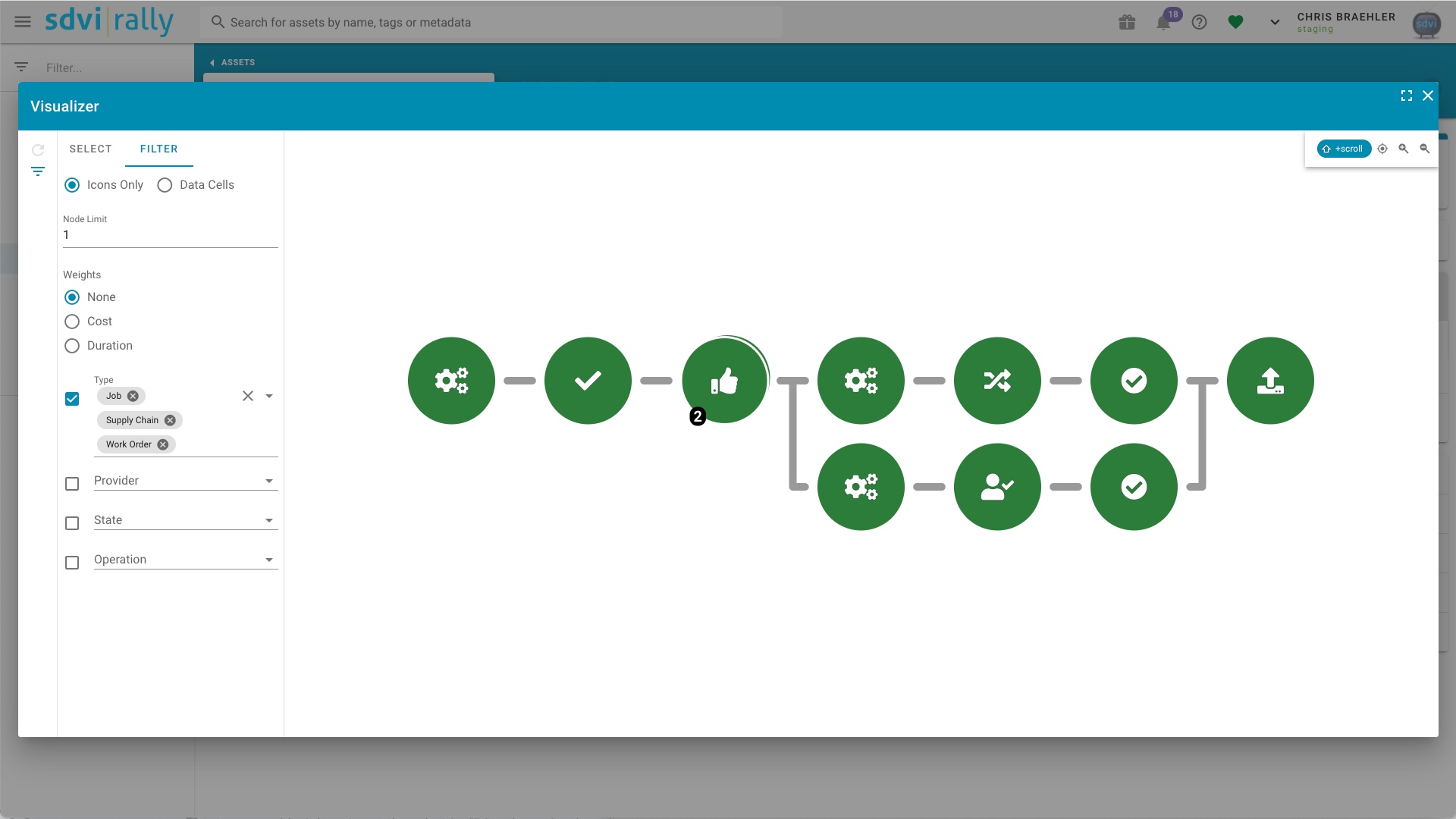
One of the headline additions is a new Graphical Supply Chain Builder, a visual interface for designing, building, and monitoring supply chain workflows. Our Solutions Team digs into what it means in practice in the section below.
Here’s what else is new:
Declarative Supply Chain Definitions
Supply chains are now defined declaratively, separating control from data — making them easier to version, audit, share, and reuse, with support for nested subchains.
Supply Chain Functions
A new modular functions layer brings reusable building blocks for common supply chain tasks — prebuilt by SDVI, or your own.
Supply Chain Rewind
Operators can now step back through supply chain execution during a live run — a powerful new tool for failure analysis and root cause investigation.
Agentic AI Interface
A new MCP (Model Context Protocol) server lets external AI systems query Rally, trigger supply chain execution, and — because Rally supply chains are human-readable — even author supply chain definitions directly.
Read more about it in the full press release and in the Solutions Team article below.
From Our Technical Solutions Team:
Graphical Designer for Next-gen Rally

Brian Pelletier, VP of Technical Solutions – Americas
If you work in media operations, you likely already know Rally as the platform many teams trust for managing complex supply chains at scale. As we announce the next generation of Rally, you might ask: what does “next generation” actually mean in practice? The answer turns out to be very compelling.

SDVI has rebuilt the orchestration engine around a declarative architecture that unlocks composable, versioned supply chains, standardized building blocks for common tasks, and a visual builder that gives operators and engineers a shared view of the entire workflow lifecycle.
But a detail that really stands out: the new architecture makes Rally a natural interface for AI agents — with an MCP server and agentic AI foundation built in from the ground up, not bolted on. For those of us living in the world of media supply chains every day, that’s the story worth watching.
In the blog, we look at the impact next-gen Rally has on real-world operations.

Partner Spotlight
Hiscale develops FLICS (Flexible Image Conversion System) — a high-performance processing engine for image and audio workflows. With advanced plugins for standards conversion, motion-compensated frame-rate conversion, image processing, and audio handling, FLICS supports all major broadcast and web formats.
Now integrated into the Rally Application Services ecosystem, FLICS gives media supply chain teams access to Hiscale’s broadcast-grade conversion capabilities directly within Rally workflows — without the overhead of standing up and managing separate on-premises infrastructure. For organizations handling large volumes of format conversion across diverse delivery requirements, it’s a powerful addition to the Rally toolbox.
Learn more about the broadest partner ecosystem for media supply chains.