update May 2026
That’s a Wrap: London Media Supply Chain Council
The SDVI Media Supply Chain Council returned to London this month and, by every measure, it was the most successful council we’ve held. Senior leaders gathered for a day of candid, peer-to-peer conversation about the realities of running and transforming modern media supply chains.

The highlight of the week: Iyuno was recognized with the NAB Show Project of the Year award for their Rally deployment. Iyuno operates at a formidable scale — 45 studios across 29 countries, processing thousands of assets per week. Their move to a cloud-native Rally supply chain changed what was operationally possible.
What makes these events work is the trust in the room. Chatham House Rules, no product pitches, invitation only — and the candor that comes with it.
Thank you to everyone who joined us in London. We’re already looking forward to the next council, coming to New York in June.
Supply Chain Thinking
Time to Value: What the London Council Told Us About Where the Industry Is Heading

Geoff Stedman, Chief Marketing Officer
One comment from a panelist in London has stayed with me. Their organization, they said, has fundamentally shifted its thinking around supply chain optimization, away from cost to value and toward time to value. The question they’re now asking is: how quickly can we take advantage of a content opportunity?
That framing resonated across the room, and it’s a useful lens through which to read everything else that was discussed during the day. Whether the conversation turned to AI, metadata, QC transformation, or FinOps, the same underlying theme kept surfacing: organizations that have committed to supply chain optimization aren’t just running leaner operations — they’re moving faster. And speed, in a world of time-sensitive licensing and rapidly shifting distribution windows, compounds in ways that are genuinely striking.
The AI discussion set the tone early: leaders talked openly about putting AI tools in the hands of operations teams to reduce repetitive, manual work, not replace people. The efficiency gains are real, and layered onto a well-optimized supply chain, they accelerate the time-to-value story considerably. The afternoon sessions brought it closer to the ground: A/B testing of metadata to drive engagement, tiered QC models that have allowed organizations to scale dramatically without adding headcount, and the new financial visibility that cloud-based, consumption-driven models are delivering to operations and finance teams alike.
In the blog, we dig deeper into each of these themes.
From Our Technical Solutions Team:
Turning Manual Metadata Into an Automated Pipeline

Brian Pelletier, VP of Technical Solutions – Americas

When the media arm of an international instruction company needed a smarter way to extract key learning cues from their course content library, they came to SDVI with a challenge that was equal parts creative and operational. Their on-demand classes were dense with instructor-driven moments: precisely-timed prompts guiding participants through adjustments, progressions, and performance targets. Capturing those “target metrics” at scale had always been a fully manual undertaking, requiring roughly three to four hours of painstaking review per thirty-minute class.
SDVI Tech Solutions engineer Ryan Eldridge took on the challenge of designing a supply chain that could change that math entirely — and what he built is a strong example of where AI-assisted media workflows are headed.

Ryan architected a Rally supply chain that orchestrates the full extraction pipeline. AWS Transcribe first processes each class video, generating a time-stamped transcript from the instructor’s audio. A user-defined connector then passes those transcripts through a large language model with tailored prompts that identify and structure the relevant instructor cues into clean JSON, automatically mapping each metric to the moment it occurs in the timeline. From there, the supply chain refines the data before surfacing it in Accurate.Video Validate, where a QC operator can review, adjust, and supplement the AI’s output before it’s formatted into a final .csv file matched to the company’s existing data structure. The entire process runs largely without manual intervention.
The results reframe what’s operationally possible for content-rich course libraries at scale. Review time in this scenario drops from three to four hours per class down to thirty to forty minutes — a reduction of more than 80% — with room to improve further as the models are refined. Beyond the metrics extraction, the AWS Transcribe-generated subtitle files unlock an additional layer of value: ready-to-use captions for on-demand course presentation, and a natural foundation for multilingual subtitle conversion that could open new markets entirely. It’s exactly the kind of compounding benefit that makes Rally workflows worth building — solve one problem, and the infrastructure you put in place quietly opens doors you hadn’t even knocked on yet.
If you’d like to explore whether your most difficult workflows can be automated using metadata, reach out to your TAM to start the conversation.
New in Rally
More Files, Broader Workflows, With Less Friction
The most recent batch of Rally updates focused on helping teams do more without adding operational overhead. Here are three highlights from the release.
Gateway: Preview Widget Workorder Mode
The Preview Widget is now available directly in Workorder Mode, so operators can verify video, audio, and subtitle alignment without leaving the workorder. Approvals made through the widget feed straight into the next supply chain step, keeping QC fast, in-context, and fully integrated with the rest of the workflow.
Gateway: Saved Input for Forms
Gateway operators can now save and recall form entries across sessions, dramatically cutting down repetitive data entry for episodic and high-volume content. Whether a session is interrupted or the same metadata pattern repeats across dozens of assets, saved inputs mean fewer keystrokes, less room for error, and faster throughput.
Gateway: Single-Page Import/Export
Rally Gateway administrators can now export individual pages from a Gateway, not just entire Gateway configurations. This makes it straightforward to import and export specific pages between Gateways, so teams can reuse and share page layouts and UX workflows across operators without carrying over an entire configuration.
These are just some of the recent updates made to the Rally platform. Read more in our latest Rally Updates blog.
Declarative Supply Chain Definitions
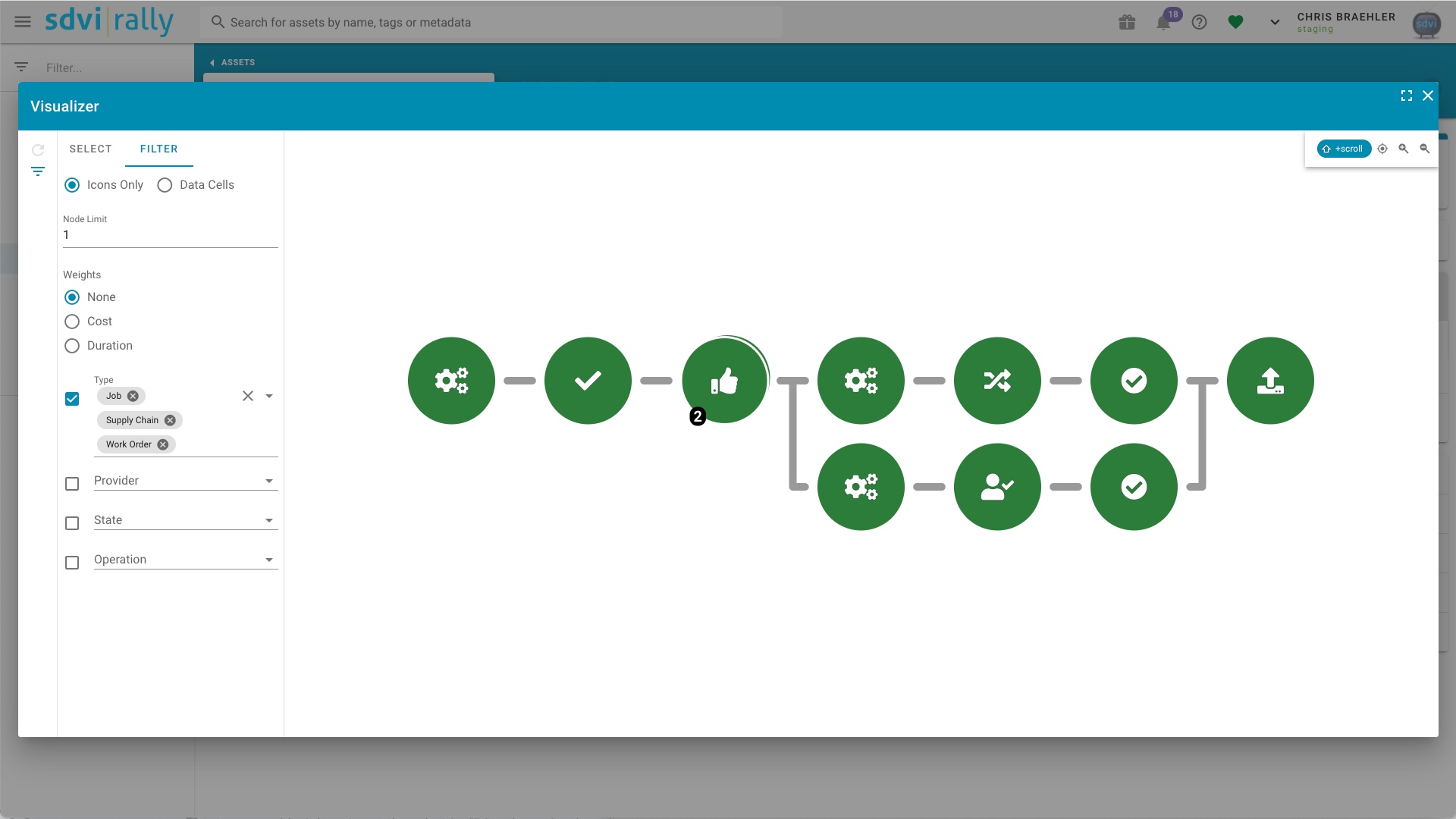
Supply chains are now defined declaratively, separating control from data — making them easier to version, audit, share, and reuse, with support for nested subchains.
Supply Chain Functions
A new modular functions layer brings reusable building blocks for common supply chain tasks — prebuilt by SDVI, or your own.
Supply Chain Rewind
Operators can now step back through supply chain execution during a live run — a powerful new tool for failure analysis and root cause investigation.

Agentic AI Interface
A new MCP (Model Context Protocol) server lets external AI systems query Rally, trigger supply chain execution, and — because Rally supply chains are human-readable — even author supply chain definitions directly.
Read more about it in the full press release and in the Solutions Team article below.

Partner Spotlight
Vionlabs develops domain-specific AI purpose-built for Media & Entertainment — trained not on generic data, but on entertainment content itself. The result is an AI that understands mood, pacing, character dynamics, and narrative structure at a level that generic models can’t match.
Available as a Rally Application Service, Vionlabs automatically analyzes video, audio, and dialogue to generate rich, time-coded metadata, including:
- mood and genre tags
- ad-break insertion points
- binge markers
- creative assets like thumbnails and preview clips
All of this metadata is returned directly to Rally and made available for downstream workflows. For media teams managing large libraries, it’s a powerful way to enrich content at catalogue scale without adding manual effort. Read the full application brief here.
Learn more about the broadest partner ecosystem for media supply chains.