Rally already orchestrates the media supply chains of some of the biggest names in media in the US and Europe, automating operations end-to-end, and the agility and efficiency gains are real. So the planning behind the next generation of Rally was not about what was broken. It was about what could be better.
Two major pillars came out of that work, and both are about you rather than the platform. The first pillar is simplicity, because supply chains involve many decisions: every decision requires logic, and logic requires people to establish it. Our customers told us they want more of their own staff to build and change supply chains, rather than routing every request through a single central team. The second pillar is agentic AI support, because the next few years of media operations will be shaped by what agents can read, reason about, and assemble, and a system that cannot be read by a model cannot be extended by one.
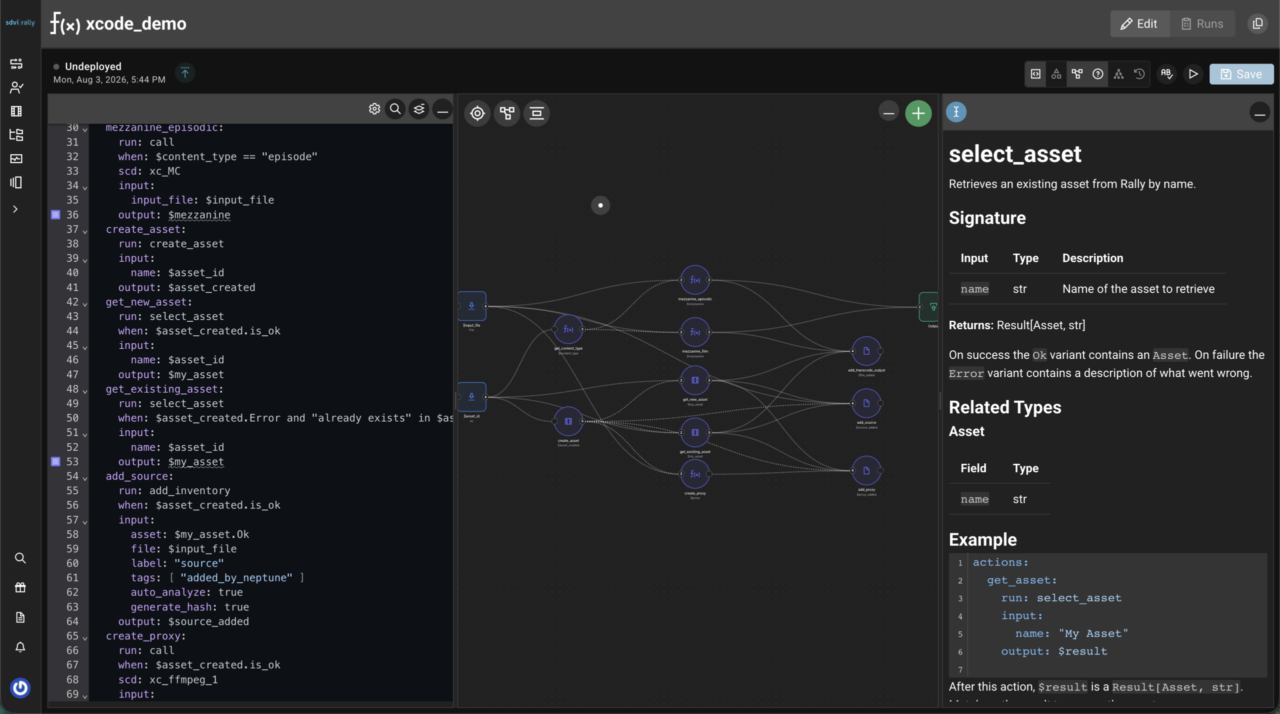
A single design choice addresses those pillars. In the next generation, a supply chain is structured text, and the graphical builder is a live rendering of that text. That single change is how the platform accommodates more builders while remaining legible to an agent, without splitting into two products. Supply chain definitions become outcome-based, so your team declares what outcome it needs rather than scripting the procedure. The integrations that only your engineers can develop — connecting the scheduling, contract, and channel planning systems that no vendor can access — remain in the hands of your operators. They are then organized into documented, reusable building blocks that the rest of your team can easily pick up and use, making collaboration smoother and more efficient. Manual steps are configured rather than custom-built, which reduces much of the friction when adding human decisions to an automated chain. And should a supply chain run make the wrong call, you want to be able to correct the value and carry on from that point rather than start the whole thing over.
None of these new developments replace what you run today. They extend it, and this is worth understanding now, because the operations teams that get value from agentic automation first will be the ones whose supply chains were already built in a form an agent can understand and work with. That is the real argument for paying attention now. The building blocks stay yours, tested and vetted by your people. What changes is how many of your people can assemble them, how fast a change reaches production, and how much of your operation is ready for the automation arriving next.
Why this matters for your operation
- Capacity to change supply chains scales with your whole team rather than with one central group — where most change requests queue up today.
- Outcome-based definitions cut the procedural plumbing out of everyday work. A change is a statement of intent rather than a rewrite.
- The integrations developed by your engineers against internal systems become documented and reusable components, ensuring that institutional knowledge accumulates instead of being lost.
- Putting a human decision inside an automated chain no longer waits on a front-end build, which shortens the path from idea to running supply chain.
- Structured supply chains are legible to AI agents, so the automation arriving over the next few years can act on work your team has already tested and approved.
Watch the walkthrough
Chris Brähler, Chief Product Officer at SDVI, walks through the next generation of Rally in a short demonstration: the builder, the new approach to manual tasks, and the new way to monitor and correct a run. It is the fastest way to see what this looks like in practice. Watch the demonstration, then talk to your SDVI account team about what it means for your supply chain.